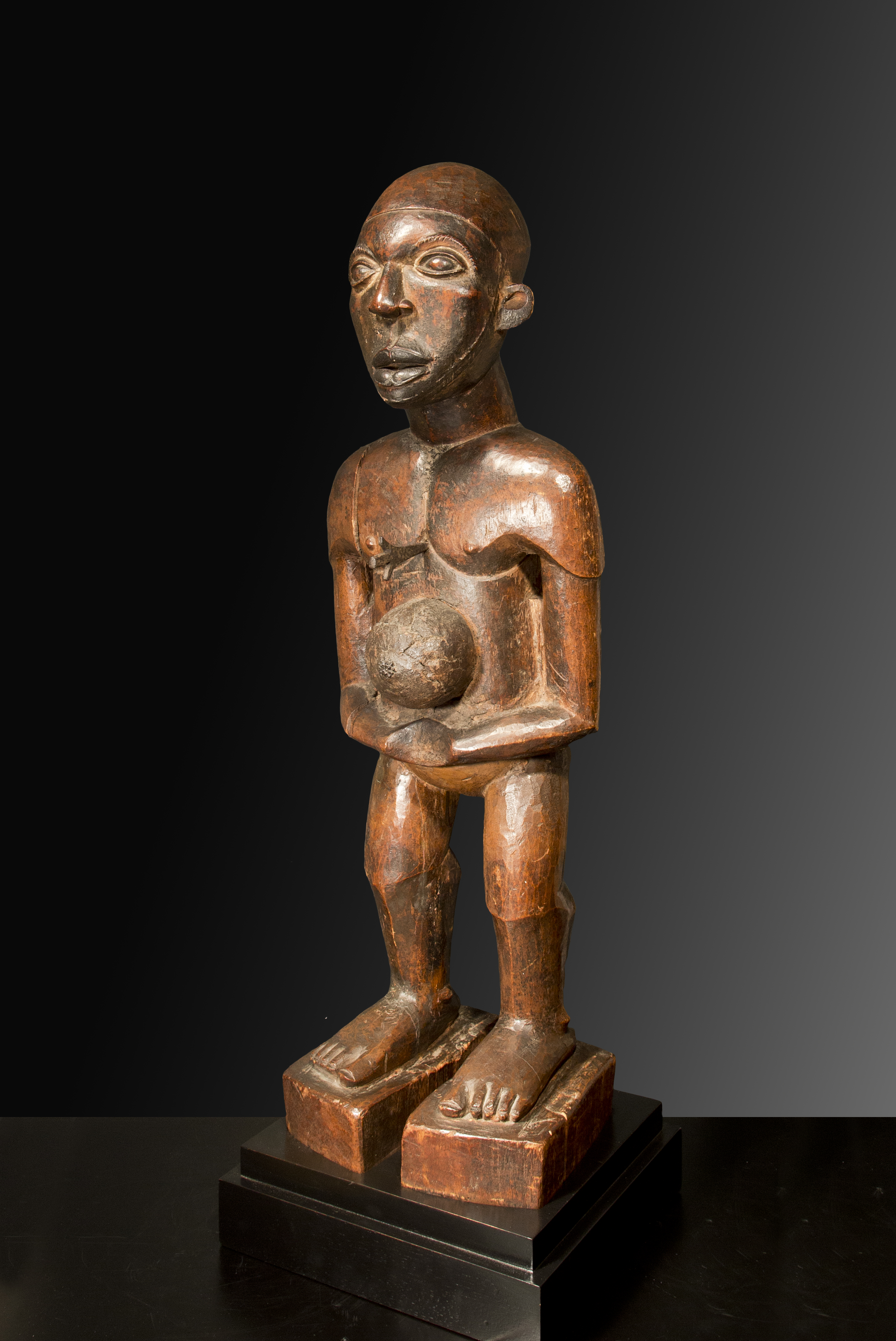
Second half of the 19th century
Wood, iron, resinous material
69.2 cm
Provenance
Helena Rubinstein Collection, New York
Private Collection, Brussels
Dalton Somaré, Milan
Anna & Vittorio M. Carini Collection, Italy
Exhibitions
Bruneaf Cultures, Brussels, 2016
Kongo statuary and the nkisi system
Kongo statuary represents one of the most complex and structured systems of African Art, in which sculpture, religion and social organization are closely interconnected.
At the centre of this system are the nkisi objects, endowed with spiritual power and conceived as containers of invisible forces activated through ritual substances.
Nkisi nkondi: function and meaning
This sculpture belongs to the type known as nkisi nkondi, “activating” or “hunting” figures used to seal oaths, resolve conflicts and protect the community.
The term nkondi derives from the verb konda, meaning “to hunt” or “to strike”, indicating the active and interventionist function of these figures.
Every element inserted into the sculpture, whether nails, blades or metal attachments, represents a precise ritual act, often linked to an oath or a request for justice.
Structure and materials
The figure is made of wood and enriched with iron elements and resinous material, which form the energetic core of the work.
These substances, often inserted into cavities on the body of the figure, were prepared by ritual specialists and considered essential to activating the power of the nkisi.
Form and presence
From a formal point of view, nkisi nkondi figures are characterized by strong plastic tension and intense visual presence.
The posture is often frontal and stable, while the face, with accentuated features, communicates authority and power.
The accumulation of metal elements on the surface accentuates dynamism and testifies to prolonged use in the ritual context.
Social and spiritual function
The nkisi nkondi were not simple religious objects, but active instruments in the management of social life: guarantors of contracts, protectors against hostile forces and mediators in conflicts.
Their presence embodied a superior authority, capable of intervening in the human world through spiritual power.
Historical context and collecting
Kongo figures of this type had a strong influence on the Western imagination and on 20th-century art, because of their expressive charge and conceptual structure.
Today they are among the most emblematic works of African Sculpture and among the most sought after in international collecting.