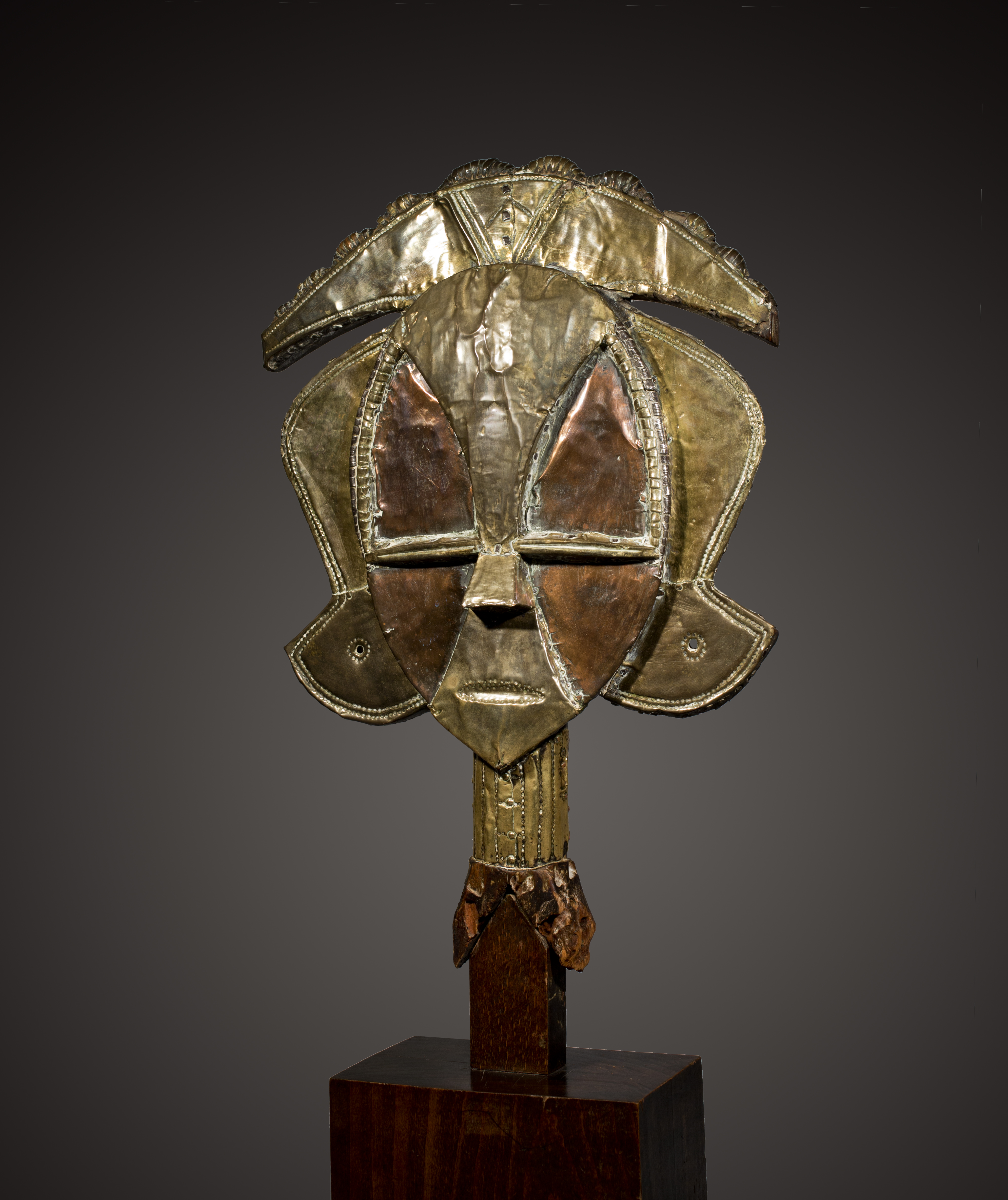
Period: 19th century
Materials: Wood, brass, copper, iron
Dimensions: 38 cm
Provenance
French Colonial Collection
Galerie Alain de Monbrison, Paris
Private Collection, Paris
Dalton Somaré, Milan
Anna Demina Collection, Helsinki
Publications
Hearts and Diamonds. Art of Gabon from the Anna Demina Collection, P. Mollfulleda, Gruppo Editoriale, Milan, 2021, pp. 72-75
Description
According to E. Anderson (Contribution to the Ethnographie des Kuta, Uppsala, 1953-54), Kota guardian figures of this type, classified by Louis Perrois and Domenico Terrana in category 5, come from southern Gabon, near the border with the Democratic Republic of the Congo.
This style is characterized by extreme stylization and a high degree of formal abstraction. The vaguely naturalistic and descriptive elements present in other variants of Kota sculpture are here completely abandoned in favour of a rigorously geometric construction.
The cylindrical pendants, generally interpreted as earrings and present in almost all other types of Kota reliquary figures, are in this case integrated into the lateral expansions surrounding the face and ending in a crescent form, echoing the profile of the broad crescent crowning the upper part of the sculpture.
The face is built through an alternation of concave and convex surfaces. From the forehead, the structure narrows at the level of the nose, reduced to a geometric solid, and then widens again in the profile of the cheeks. The eyes and mouth are reduced to thin horizontal slits, whose essentiality gives the figure authority and mystery.
The refined play of forms is accentuated by the skillful use of different metals, arranged with great precision on the wooden structure. This example, which because of its notable age may be considered an archetype of the style, is also distinguished by the sequence of metal wrappings decorating the upper edge of the crescent and by the double stitching of brass and iron bands around the temples.
This refined singularity, besides increasing the aesthetic quality of the sculpture, indirectly confirms the cultural attention devoted to the making of the object and its importance in the ritual and social context of origin. The figure thus stands among the most significant testimonies of ancient African Art and of the Kota reliquary tradition of Gabon.