Early 20th century
Wood
49 cm
Provenance
Kelley Rollings Collection, Tucson
Pace Gallery, New York
Dalton Somaré, Milan
Anna and Vittorio M. Carini Collection, Bergamo
Publications
Parcours des Mondes, catalogue, Paris, 2010
I. Bargna, G. Parodi da Passano, L’Africa delle Meraviglie, Silvana Editoriale, Milan, 2010, p. 147
Marco Scotini, Il Cacciatore Bianco, FM Centro per l’Arte Contemporanea, Milan, 2017, p. 114
Entre Grâce et Brutalité. La Côte d’Ivoire dans les collections italiennes, Dalton Somaré, Milan, 2017, pp. 70-71
Exhibitions
L’Africa delle Meraviglie, Palazzo Ducale, Genoa, 2010
Il Cacciatore Bianco, FM Centro per l’Arte Contemporanea, Milan, 2017
Blolo bian figures and Baule sculpture from Ivory Coast
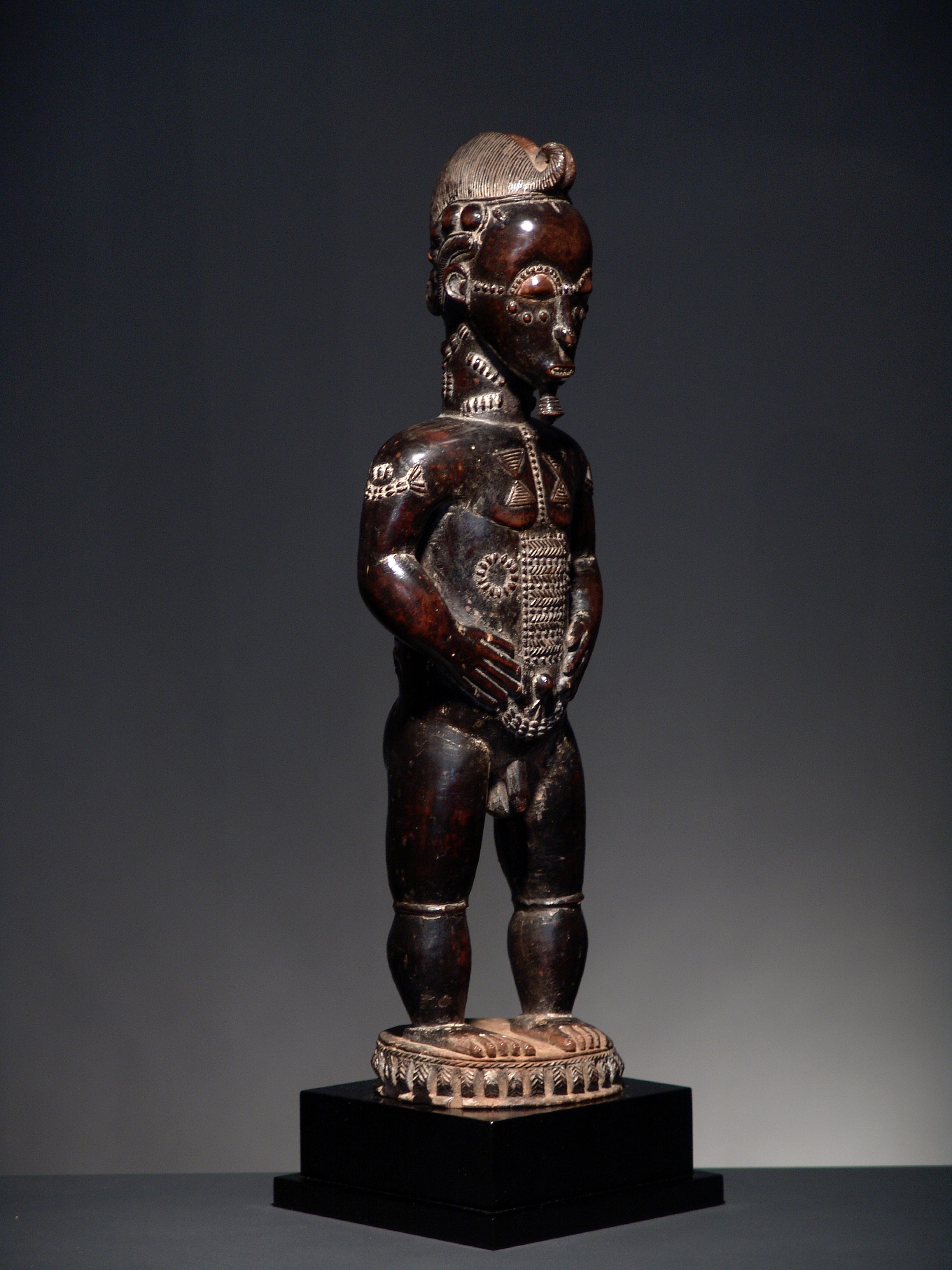
Baule sculpture from Ivory Coast is characterized by a great balance between naturalism, idealization and formal synthesis.
Baule anthropomorphic figures should not be interpreted as images of ancestors. They mainly belong to two broad categories: figures connected with the asie usu, spirits of the bush whose favour could be obtained through the intervention of a diviner (komyem), and blolo bla or blolo bian figures, respectively wife and husband from the parallel world.
The latter are connected with the Baule belief in the existence of an invisible universe, the blolo, mirroring that of the living. According to Baule cosmology, every individual has a spiritual spouse in the invisible world, with whom a personal relationship is maintained through offerings, devotion and ritual practices intended to preserve balance, fertility and prosperity.
In the absence of precise information on the original context of use, distinguishing with certainty between different types of Baule figures can be complex. However, the surface of the sculpture may offer significant indications. Figures associated with spirit spouses of the blolo generally have carefully cleaned surfaces and luminous patinas, without consistent deposits of kaolin or sacrificial matter.
From a formal point of view, this Blolo Bian figure is distinguished by the fluidity of the volumes and the harmony of the proportions, fundamental characteristics of Baule statuary. The body is constructed through plastic continuity that avoids sharp breaks and generates a soft, coherent and perfectly balanced surface.
As in the highest Baule productions, the head is emphasized in proportion, reflecting the importance attributed to the spiritual dimension and to the seat of identity. It also expresses the typical “balanced asymmetry” of Baule art, capable of creating formal vitality without compromising the overall equilibrium of the composition.
The expression of the face is composed and controlled, without dramatic tension, and conveys a sense of dignity, inner harmony and silent authority. Elements such as hairstyle, scarifications and posture help define an aesthetic and moral ideal based on order, self-control and beauty.
The patina, derived from prolonged ritual and devotional use, gives the sculpture visual depth and testifies to the direct relationship established between the object and its owner. This example is also distinguished by formal quality, provenance and stylistic coherence, placing it among the most significant testimonies of ancient Baule sculpture.
Blolo Bian figures are now considered among the most important and sought-after works in international collecting of African Art, thanks to their intimate dimension, symbolic complexity and extraordinary synthesis of naturalism and abstraction.
Further reading
Related Sculptures
- Mask Deanglé Dan, Ivory Coast
- Mask Dan, Toura Area, Ivory Coast
- Female Figure Dan-Gio, Ivory Coast
- Male Figure Baule, Ivory Coast
- Female Figure Baule, Ivory Coast
- Portrait Mask Baule, Ivory Coast
- Portrait Mask Sakassou Workshop Baule, Ivory Coast
- Kpelye Face Mask Senufo, Ivory Coast
- Horse Rider Ligbi/Senufo, Ivory Coast