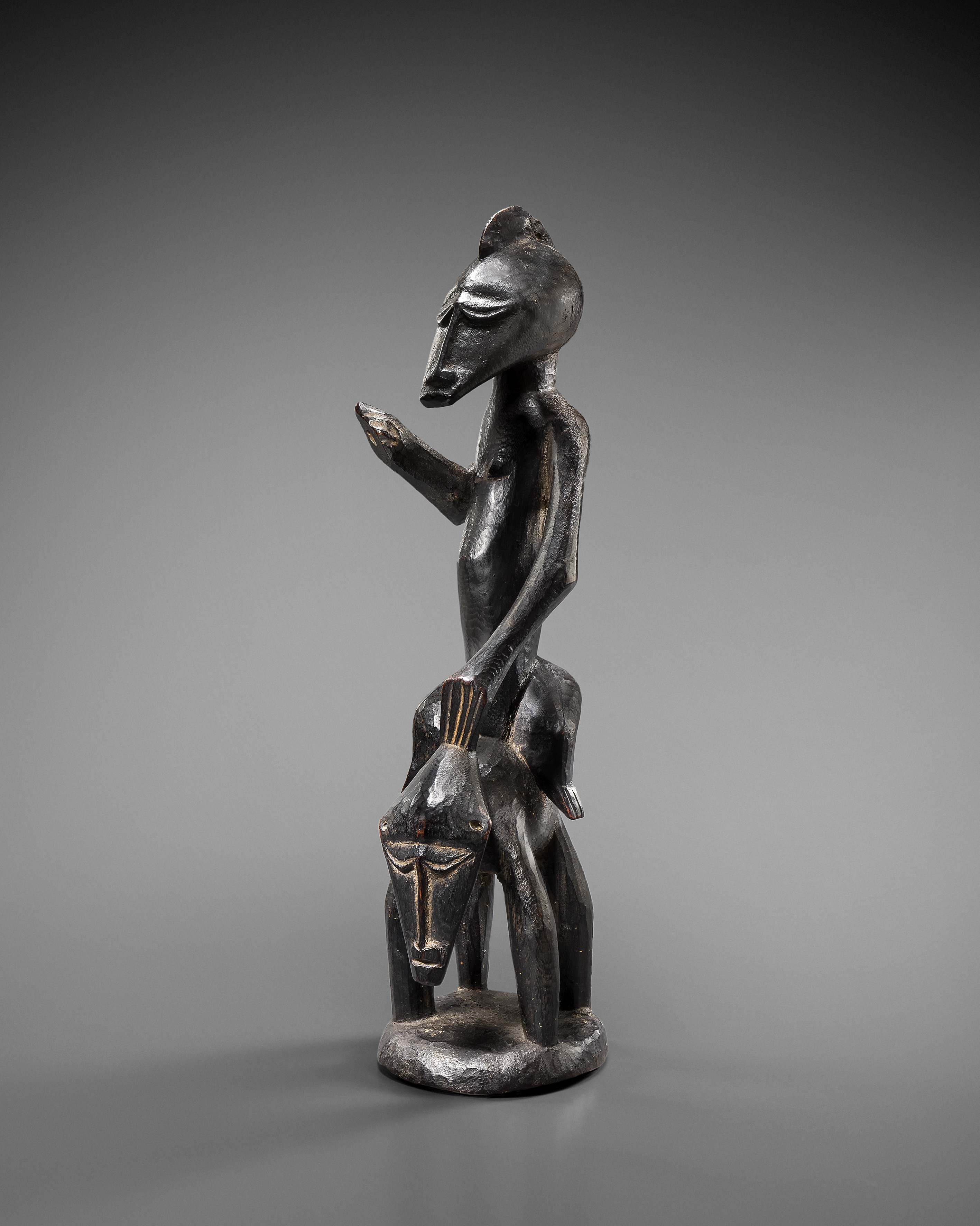
Early 20th century
Wood
36.5 cm
Provenance
Adrian Schlag, Brussels
Galerie Philippe Ratton, Paris
Private Collection, Paris
Dalton Somaré, Milan
Private Collection, Milan
Publications and exhibitions
Sénoufo, Galerie Olivier Castellano, Paris, 2014, pp. 88–89
La région lagunaire, Adrian Schlag, Parcours des Mondes, 2016, pp. 62–65
Senufo art and Ligbi influence
Senufo sculpture from Ivory Coast is one of the most dynamic and rhythmic expressions of African Art.
Equestrian figures, widespread in the Senufo area and also adopted by the Ligbi, constitute a relatively rare iconographic theme, but one of great symbolic force.
Among the Ligbi, these representations are less frequent than in Senufo production, while showing clear stylistic affinity.
The rider as a symbol of power
These figures, known as syonfolo or fanhafolo, can be interpreted as “masters of the horse” or “holders of power”.
The introduction of the horse into West Africa, beginning in the 8th century, profoundly transformed military and political organization, making the rider a symbol of authority, prestige and domination.
For centuries, riders were associated with warriors, emissaries and conquerors, entering the collective imagination as almost supernatural figures.
Historical context and cultural memory
In the Senufo region, this theme developed especially during the incursions of Samori Touré’s armies in the 19th century.
Even after the end of these events, the image of the rider continued to evoke power, violence and the need for defence, but also prosperity, since possession of a horse was reserved for few.
Spiritual dimension
According to tradition, the rider is also associated with bush spirits, invisible and powerful entities that manifest themselves at night.
The possession of such a figure by a diviner indicated prestige and success in divinatory practice.
Form and stylistic language
From a formal point of view, the sculpture is distinguished by what Paul Guillaume defined as the “continuous rhythm of forms”, like a musical variation on a theme.
The flowing lines and harmonious construction of the volumes create a dynamic composition, in which figure and horse merge into a single movement.
Patina and presence
The black and unctuous patina accentuates the continuity of the surfaces and gives the sculpture a vibrant visual quality, almost in motion.
Context and collecting
Senufo and Ligbi rider figures are now particularly appreciated for their rarity and for their ability to synthesize power, history and symbolism in a highly expressive form.
Further reading
Related Sculptures
- Mask Deanglé Dan, Ivory Coast
- Mask Dan, Toura Area, Ivory Coast
- Female Figure Dan-Gio, Ivory Coast
- Male Figure Baule, Ivory Coast
- Male Figure Blolo Bian Baule, Ivory Coast
- Female Figure Baule, Ivory Coast
- Portrait Mask Baule, Ivory Coast
- Portrait Mask Sakassou Workshop Baule, Ivory Coast
- Kpelye Face Mask Senufo, Ivory Coast