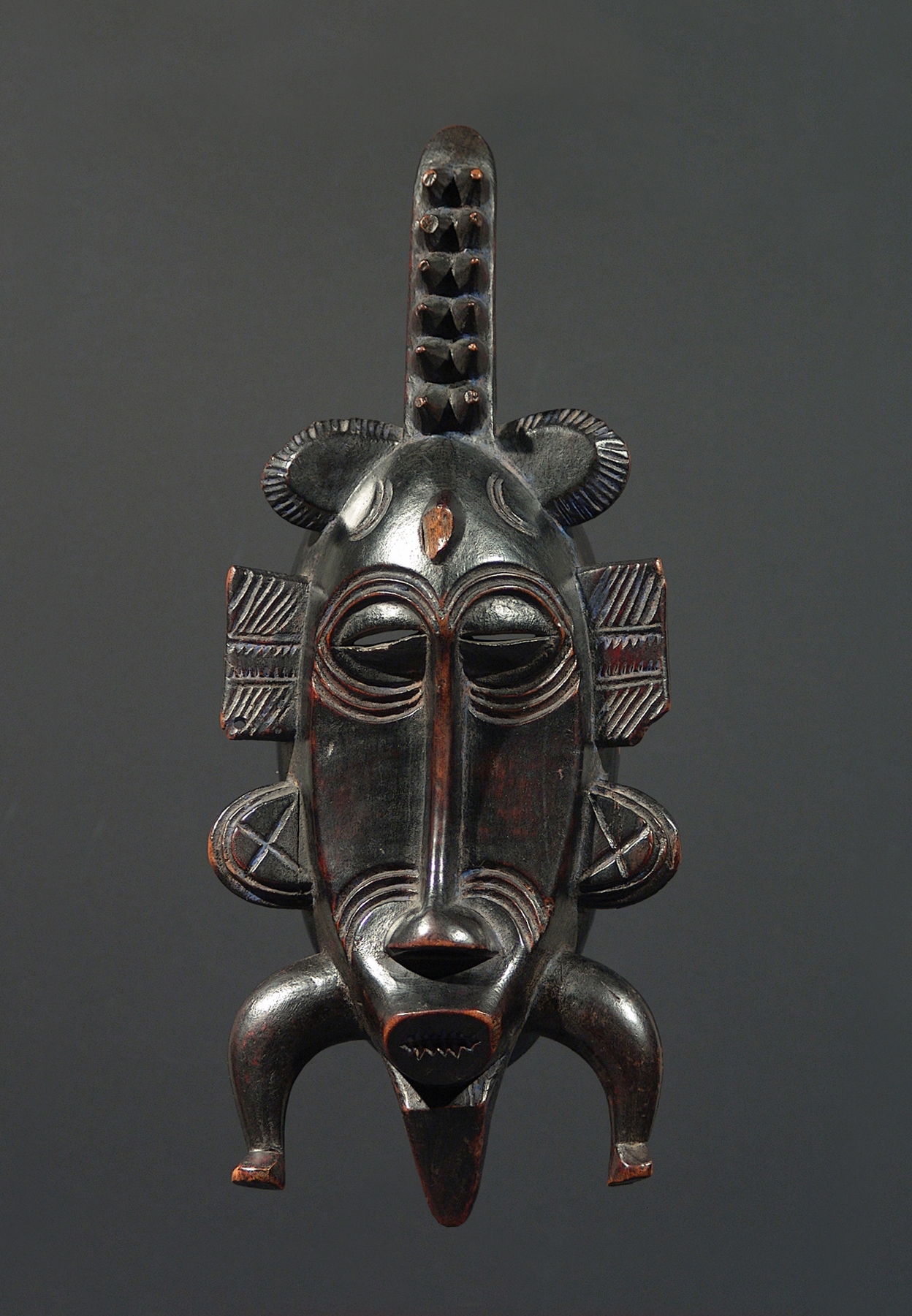
Early 20th century
Wood, dark patina, pigments
34 cm
Provenance
Maria & Paul Wyss, Basel
E. Winizky Collection, Zurich
Christine Valuet, Paris
Dalton Somaré, Milan
Private Collection, Los Angeles
Leinuo Zhang Collection, Milan
Exhibitions
Die Kunst der Senufo, Rietberg Museum, Zurich, 1988
Publications
T. Föster and L. Homberger, Die Kunst der Senufo, Rietberg Museum, Zurich, 1988, p. 37
V. Carini, A Hidden Heritage, Dalton Somaré, Milan, 2004, p. 151
M. Riccomini et alii, Souls – Masks from the Leinuo Zhang African Art Collection, 5 Continents Edition, Milan, pp. 48-53
Kpelye Senufo masks: function and meaning
Senufo sculpture from Ivory Coast is closely connected with the Poro initiation system, one of the most complex social and religious institutions in West Africa.
Within this system, masks play a fundamental role in the transmission of moral values, symbolic knowledge and communal identity.
Kpelye masks, considered feminine in nature, are worn by men during rites of passage between age classes.
They embody a benevolent spirit, capable of protecting and assisting the community, and are distinguished by an expression that is delicate, introspective and at the same time slightly assertive.
The symbolism of Kpelye masks is extremely complex and not entirely deciphered.
In the mask in question, the upper crest may be interpreted as a representation of cultivators, while the frontal protuberance is often associated with the kola nut, a central element in the social and ritual life of West Africa.
The lower appendages, similar to stylized legs, are generally interpreted as references to the hornbill, an animal symbolically connected with the spiritual world and the ancestors.
Form and stylistic language
The composition of the mask is based on a refined balance between abstraction and recognizability.
The polished surfaces and symmetrical structure are interrupted by dynamic elements that introduce rhythm and visual tension.
This highly codified formal language reflects a conception of sculpture as a symbolic system rather than as naturalistic representation.
African Art and modernity
The importance of these forms was recognized early by European artists and theorists.
The fact that this mask can be attributed to the same master as the celebrated sculpture published in Carl Einstein’s Neger Plastik (1915) underlines the fundamental role of African Sculpture in the definition of artistic modernity.
Further reading
Related Sculptures
- Mask Deanglé Dan, Ivory Coast
- Mask Dan, Toura Area, Ivory Coast
- Female Figure Dan-Gio, Ivory Coast
- Male Figure Baule, Ivory Coast
- Male Figure Blolo Bian Baule, Ivory Coast
- Female Figure Baule, Ivory Coast
- Portrait Mask Baule, Ivory Coast
- Portrait Mask Sakassou Workshop Baule, Ivory Coast
- Horse Rider Ligbi/Senufo, Ivory Coast