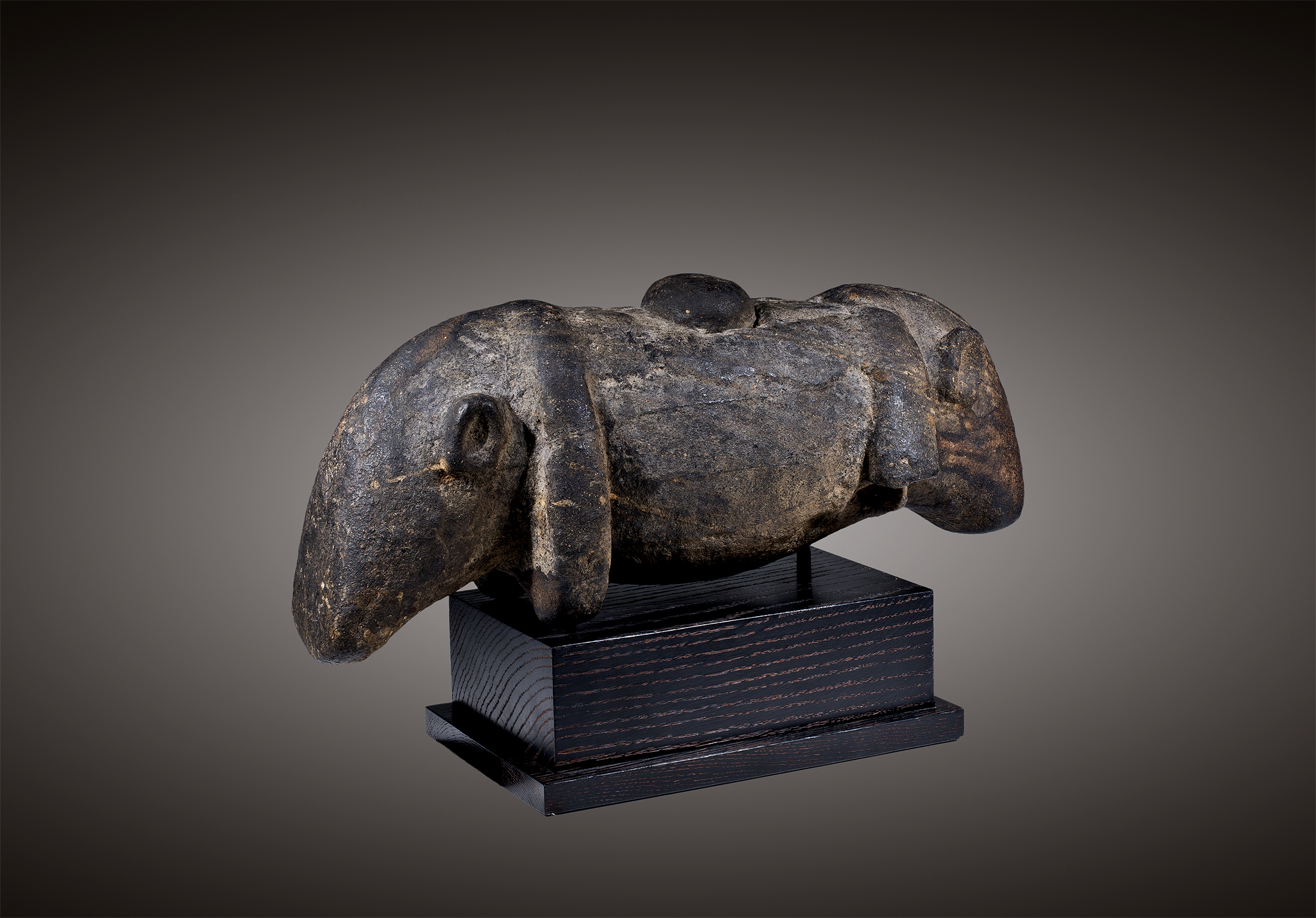
1309–1424 A.D. (C14 tested)
Wood, stone
42.5 cm
Provenance
Important French Collection, acquired in 1972
Jean-Claude Marian Collection, Brussels
Carlos Basso Collection, Barcelona
Private Collection, Paris
Description
The Tellem Dogon zoomorphic figure presented here belongs to a particularly complex historical and cultural context. The chronology of migrations in the Inland Niger Delta, still only partially understood, does not allow the surviving religious wooden carvings of this region to be attributed with absolute certainty to a specific ethnic group.
The area extending from the ancient city of Djenné-Djeno through Djenné and Mopti to the Bandiagara Cliff was affected, between the 11th and 16th centuries, by successive waves of migration that created a highly composite cultural environment. The still mysterious Tellem, a Dogon term meaning “those who were here before”, had settled in the caves of the cliff between the 10th and 11th centuries. During the 11th and 12th centuries, several Soninké clans fleeing the violent Islamization imposed by the Almoravids joined them. Later, from the beginning of the 15th century onward, the Dogon themselves settled in the region, equally attracted by the inaccessibility of the cliff.
According to the C14 dating, this Janus-headed zoomorphic figure must therefore be attributed either to the Tellem or to a very early phase of Dogon presence, introducing us to the earliest iconographic traditions of the Inland Niger Delta.
As noted by Kate Ezra, Dogon statuary is connected to a vast body of myths concerning the creation of the universe, the struggle between order and disorder, and the place of humankind within it. Zoomorphic figures are not uncommon in this region. Frequently identified as “dogs”, these sacred images are often associated with the historical migrations of the Dogon toward the Bandiagara Cliff, where the dog is believed to have guided the people toward water sources, as described by Jean Laude.
A morphological examination of this sculpture, however, makes the identification of the represented animal as a dog problematic. The rounded volumes of the body, the shape of the skull and muzzle, the position of the ears, and the overall attitude of the animal appear more closely related to a hippopotamus. It should also be noted that the marked difference in scale between the two animal heads cannot be considered accidental, but most likely refers to the sexual dimorphism between the male and female of this large mammal.
A final observation concerns the stone fixed at the center of the figure’s back. Its rounded shape excludes the possibility that it functioned as a support point or sacrificial altar, such as the small bowls found on several other zoomorphic figures. Its smooth surface instead recalls the dugo, sacred stones given by Amma to humankind, in which the nyama, the vital force of the ancestral progenitors, is believed to reside.
Large-scale Tellem-Dogon zoomorphic figures are exceedingly rare. One example is preserved in the collections of the Musée Dapper in Paris, formerly in the Lester Wunderman Collection, New York, while a second belongs to the Metropolitan Museum of Art, New York, formerly in the Nelson Rockefeller Collection. Both sculptures are single-headed and feature a small empty cavity at the center of the back. The present work stands out both for its Janus-headed iconography and for the presence of the magical stone placed on its back, a feature that makes it an absolute unicum.