Kuba ceremonial cups: prestige, refinement and social display
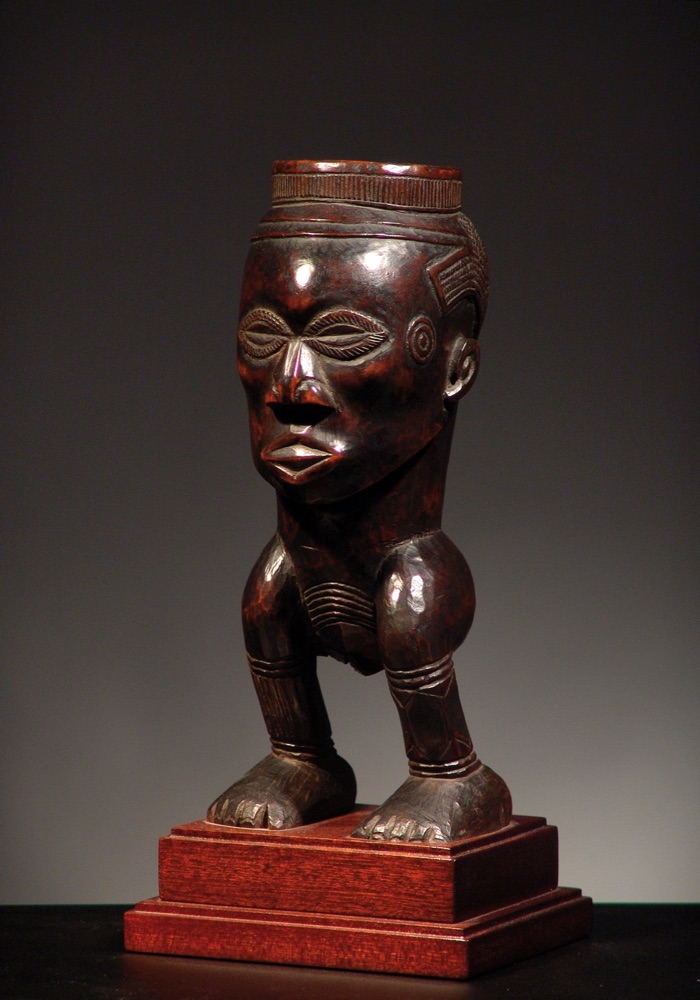
Kuba ceremonial cups from the Democratic Republic of the Congo are among the most refined prestige objects of Central African art. Often associated with the consumption and presentation of palm wine, these cups were not ordinary utensils. Their carved surfaces, anthropomorphic forms and polished patina indicate status, social distinction and courtly sophistication.
The human head, the elaborate hairstyle and the careful modeling of facial features transform the container into an image of authority. The cup becomes a sculptural object in which function and representation are inseparable. Handling, display and exchange contributed to its meaning, while repeated use could deepen the surface and intensify its presence.
Within the wider field of African art, Kuba cups reveal the importance of small-scale sculpture in systems of prestige. They demonstrate that monumentality does not depend on size, but on formal intensity, social value and the concentration of symbolic meaning.
Bibliography and comparisons
- Jan Vansina, The Children of Woot, for Kuba history and political culture.
- Monni Adams, studies on Kuba art, for social and formal interpretation.
- Metropolitan Museum of Art, Kuba cup, for museum examples.
- British Museum, Kuba cup, for comparisons.