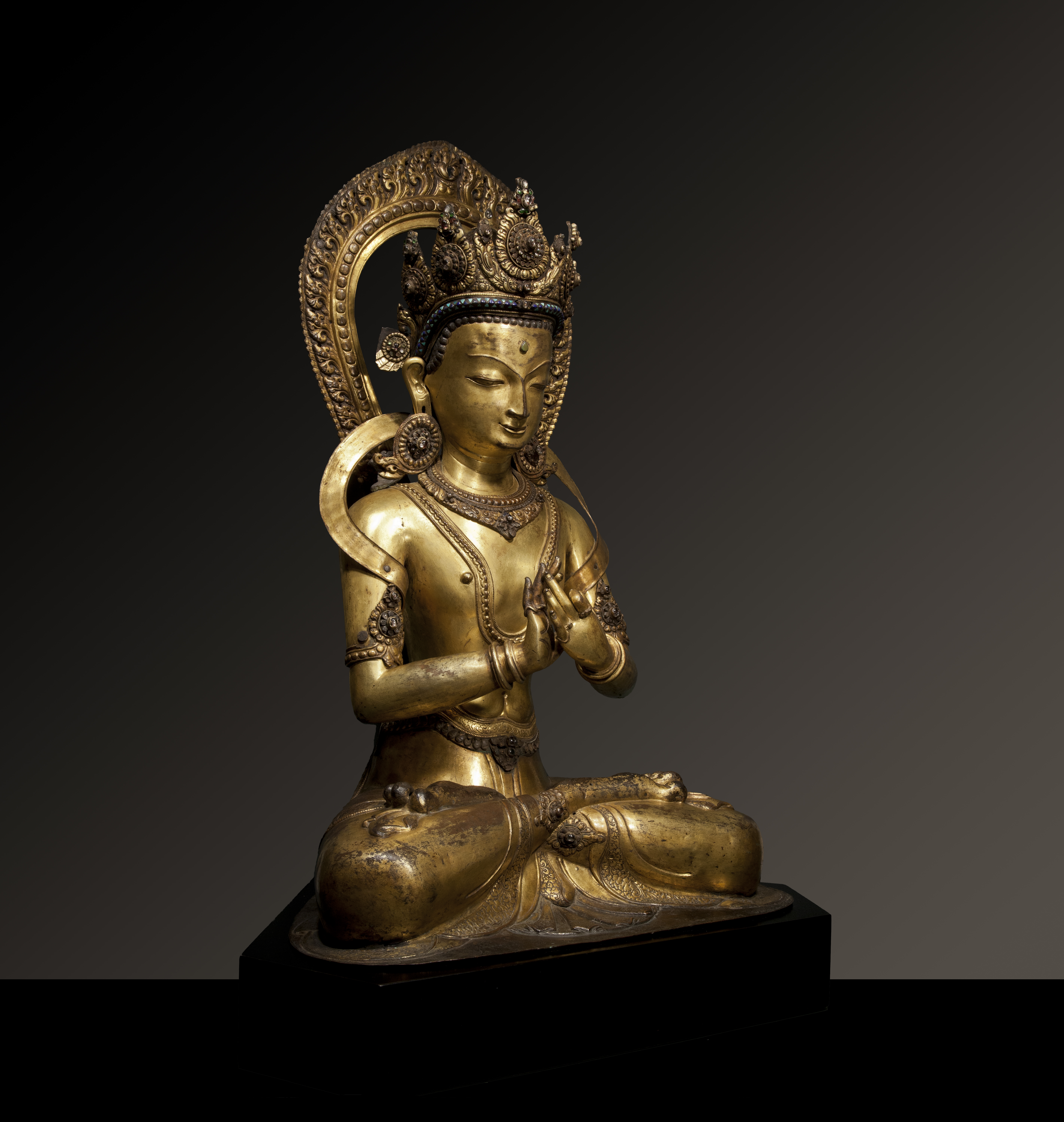
Period: 16th century
Materials: Gilt repoussé copper with semi-precious stones
Dimensions: 63 cm
This sixteenth-century Nepalese bodhisattva holds the hands in dharmachakra mudra, the gesture of turning the Wheel of the Law. It refers to the Buddha’s first sermon at Sarnath and the transmission of Buddhist teaching.
Description
The crown, jewellery and halo give the bodhisattva the regal appearance associated with this iconography. The hands focus attention before the chest, while the ornaments surround the face and torso. Broadly modelled body surfaces contrast with the smaller decorative reliefs. The image’s meaning emerges through the relationship between the pose, the teaching gesture and its rich ornamentation.
The work belongs to the tradition of Newar artisans of the Kathmandu Valley. Repoussé shapes thin copper sheets to create the volume of the body and the ornamental reliefs; gilding and semi-precious stones enrich the surface.
The symmetry of the composition and the clarity of its volumes reflect the language of Nepalese sculpture of the Malla period. At 63 centimetres in height, the image forms part of the production of works intended for worship and devotional practice.