Period: Late 19th century – early 20th century
Materials: Wood
Dimensions: 31 cm
Provenance
Galerie R. Rasmussen, Paris
Private Collection, Paris
Pace Gallery, New York
Dalton Somaré Gallery, Milan
Anna & Vittorio M. Carini Collection, Bergamo
Exhibitions
Africa. The Land of Spirits, MUDEC, Milan, 2015
Parcours des Mondes, Paris, 2017
Publications
C. Zevi, G. Pezzoli, Africa. The Land of Spirits, 24Ore Cultura, Milan, 2015, p. 287
Entre Grâce et Brutalité. La Côte d’Ivoire dans les collections italiennes, Dalton Somaré, Milan, 2017, p. 67
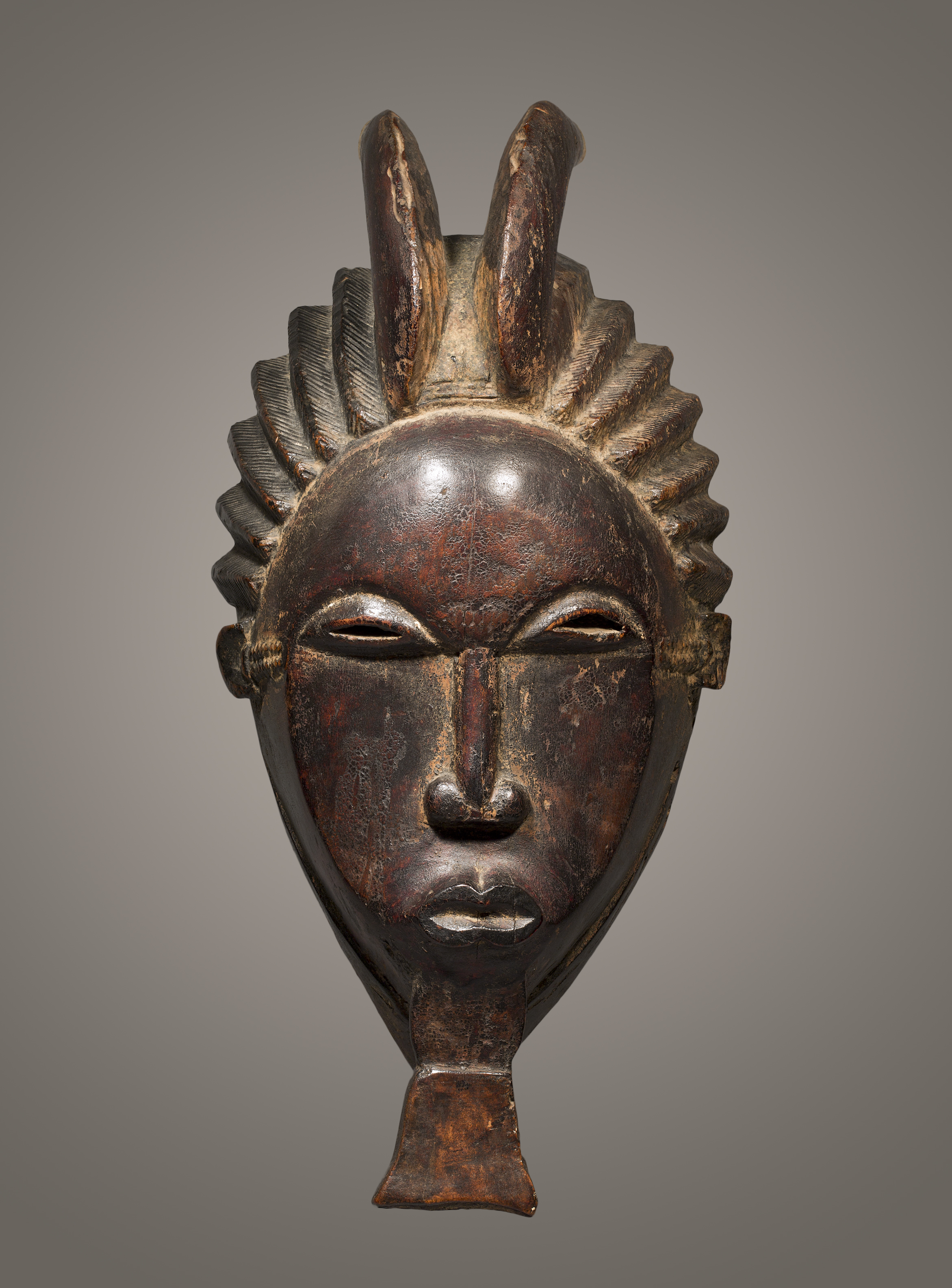
Baule art and portrait masks
Baule sculpture is among the most refined expressions of African Art, characterized by a remarkable balance between ideal beauty and observed reality. Portrait masks in Baule culture do not aim at strict individual likeness but rather at expressing an ideal of harmony, dignity and social order.
These masks were used in public ceremonies and performances, often associated with dance and communal events. Even when inspired by real individuals, they represent an aesthetic transformation, elevating the subject to a symbolic and idealized level.
The face is defined by smooth surfaces, balanced proportions and controlled symmetry. Scarifications, hairstyle and facial details function as coded elements, expressing identity, status and cultural values.
A meaningful comparison can be drawn with portrait masks of the Dan people of Ivory Coast and Liberia. Within the Dan tradition, certain masks, though linked to initiation systems such as the Poro society, display a striking attention to individual features, sometimes approaching true portraiture. Unlike the serene idealization of Baule masks, Dan masks often emphasize expressive tension and psychological intensity. This contrast reveals two distinct artistic approaches: Baule harmony and Dan expressive dynamism.
The finely polished surface reflects careful craftsmanship, while the patina bears witness to ritual use and historical depth.
Baule masks are highly prized for their formal refinement and their ability to synthesize aesthetic and symbolic values. This example, with its distinguished provenance and museum exhibition history, stands as an important work within the tradition.