Period: Early 20th century
Materials: Wood, fibers, bone (Nandinia binotata)
Dimensions: 26 cm
Provenance
Collected by a U.S. diplomat while stationed in Liberia between 1935 and 1937
Private Collection, California, and thence by descent
Cole Harrell, New York, acquired from the above
Dalton Somaré, Milan
Leinuo Zhang Collection, Milan
Publications
Origins: a vision on African Art, Anna Demina & Leinuo Zhang Collection, Dalton Somaré, Milan, 2019, pp. 12-15
Souls-Âmes. The Leinuo Zhang African Art Collection: Masks from Leinuo Zhang African Art Collection, 2023
Mano mask and the art of West Africa
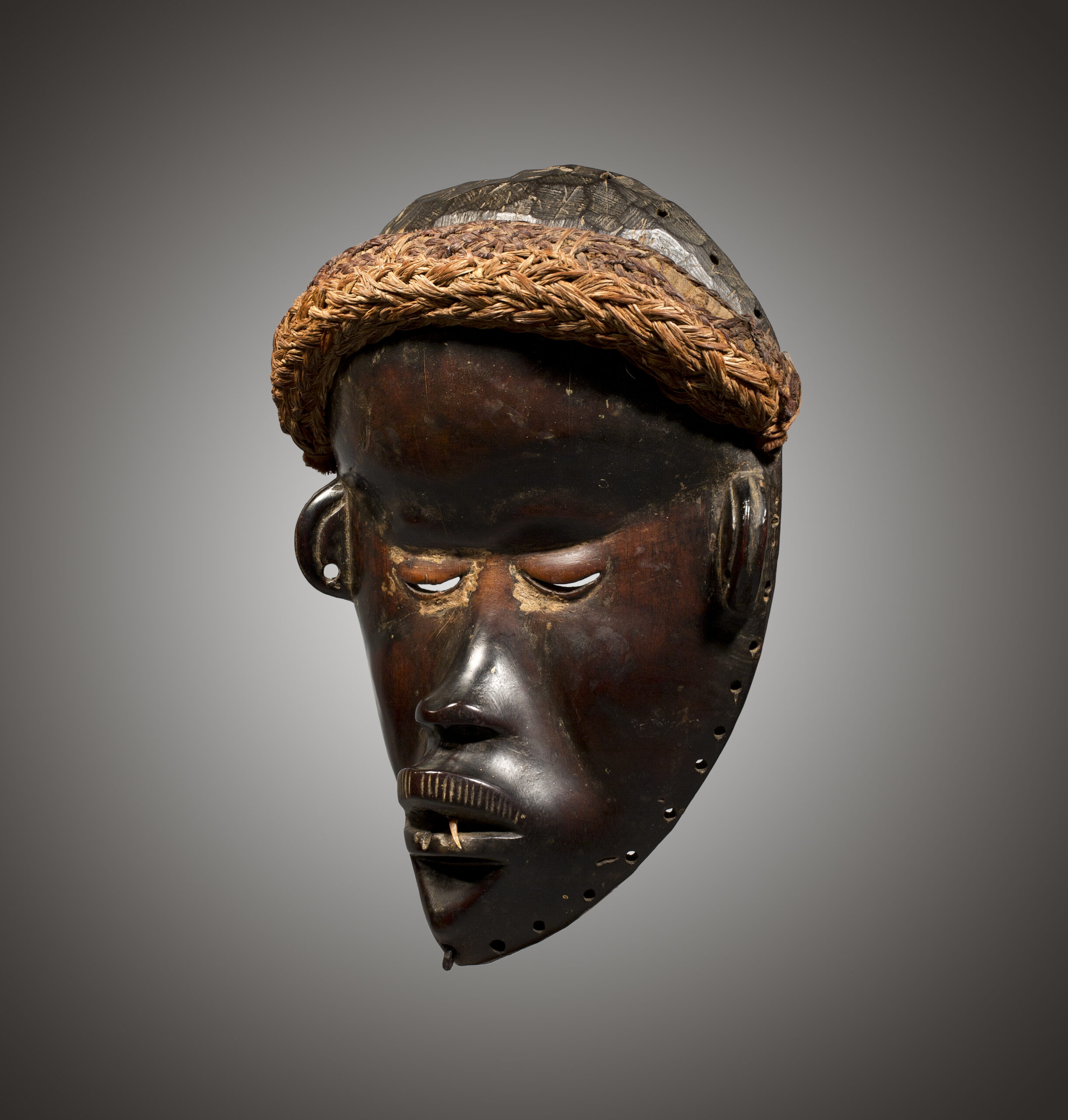
The Mano live in north-eastern Liberia, along the border with Ivory Coast. Their cultural proximity to the Dan exerted an evident influence on their artistic production, which nevertheless preserved fully autonomous stylistic characteristics and sensitivity. Like the Dan, the Mano also share the institution of the Poro initiation society, whose rituals involve the use of masks with spiritual, educational and protective functions. Traditionally, the guardian mask of initiation ceremonies represents a female face and is venerated as the mother of all other masks. Generally kept by the oldest woman of the clan, this Mano mask appeared in public as guardian of the secret initiation rituals, with the task of preventing strangers from entering the sacred ground of the ceremonies.
The intense and almost suffering expression of the face, the prominent forehead emphasizing the mysterious slits of the half-closed eyes and the perfection of the delicate features give the mask a presence of extraordinary spiritual force. The splendid glossy brown patina accentuates the softness of the modelling and amplifies the luminous quality of the surface, creating an image suspended between naturalism and ritual idealization. This ancient Mano mask from Liberia is one of the highest examples of Mano sculpture and testifies to the ability of West African artists to translate spiritual authority, formal balance and psychological intensity into images of great elegance and symbolic depth.
Further reading
Related Sculptures
- Mask Deanglé Dan, Ivory Coast
- Mask Dan, Toura Area, Ivory Coast
- Female Figure Dan-Gio, Ivory Coast
- Male Figure Baule, Ivory Coast
- Male Figure Blolo Bian Baule, Ivory Coast
- Female Figure Baule, Ivory Coast
- Portrait Mask Baule, Ivory Coast
- Portrait Mask Sakassou Workshop Baule, Ivory Coast
- Kpelye Face Mask Senufo, Ivory Coast
- Horse Rider Ligbi/Senufo, Ivory Coast